
December 15
Bill of Rights Day lesson: the first ten amendments in plain words, in 25 minutes
A free, no prep Bill of Rights Day lesson for grades 4 to 8: how the first ten amendments came to be, what they protect in plain words, and a matching activity.
What it is
The Bill of Rights is the first ten amendments to the U.S. Constitution. On September 25, 1789, the First Congress proposed 12 amendments. Ten of the 12 were ratified by three-fourths of the state legislatures on December 15, 1791, and those ten became the Bill of Rights.
The Bill of Rights was a promise. According to the National Archives, the Constitution might never have been ratified if the framers had not promised to add a Bill of Rights. James Madison introduced a list of amendments on June 8, 1789.
In plain words, the amendments protect rights of the people and set limits on what the government can do. The First protects freedom of speech, the press, assembly, petition and religion. The Second protects the right to keep and bear arms, and the Third limits the housing of soldiers in homes. The Fourth bars unreasonable searches, and the Fifth through the Eighth set rules for fair treatment when someone is accused of a crime or a case goes to court. The Ninth says that listing some rights does not mean people have no others, and the Tenth says that powers not given to the federal government belong to the states or the people.
In 1941, for the 150th anniversary, Congress authorized a presidential proclamation designating December 15, 1941 as Bill of Rights Day, and President Franklin D. Roosevelt issued it. Since 1962 the President has acknowledged Bill of Rights Day every year.
How to run it
25 minutes, 5 steps. The time on the left is when each step starts.
-
0:00
Warm-up
4 minOn the boardA new country writes a list of promises its government must keep to its people. Write three promises you would put on the list.
You do- Students write three promises alone for two minutes.
- Take five promises from the room and write them on the board. Do not judge them.
- Tell students that the class list will be compared with the real list in a few minutes.
Say: There are no wrong answers yet. The question is what a government should never be allowed to do to people.
-
4:00
The story in five facts
6 minOn the board- September 25, 1789: the First Congress proposes 12 amendments to the Constitution.
- December 15, 1791: ten of the 12 are ratified by three-fourths of the state legislatures. They become the Bill of Rights.
- The Constitution might never have been ratified if the framers had not promised to add a Bill of Rights.
- The First Amendment protects freedom of speech, the press, assembly, petition and religion.
- The Ninth Amendment says that listing some rights does not mean people have no others.
You do- Read the five facts aloud, one at a time.
- After fact 3, ask why states might want a promise before they approve a new Constitution. Take two answers.
- After fact 5, ask which promises on the board list match something in the facts.
Say: A bill of rights is a list of things the government promises not to do, and of rights it promises to protect.
-
10:00
The ten in plain words
7 minOn the boardAmendment 1: speech, the press, assembly, petition and religion. Amendment 2: the right to keep and bear arms. Amendment 3: no soldiers in a home in peacetime without the owner's consent. Amendment 4: no unreasonable searches and seizures. Amendment 5: protections for people accused of crimes, including a grand jury for serious charges, no second trial for the same offense, no forced self-incrimination, due process, and fair payment when property is taken. Amendment 6: in criminal cases, a speedy and public trial, an impartial jury, notice of the charges, facing the witnesses, and a lawyer. Amendment 7: a jury trial in federal civil cases. Amendment 8: no excessive bail or fines and no cruel and unusual punishment. Amendment 9: listing some rights does not mean people have no others. Amendment 10: powers not given to the federal government belong to the states or the people.
You do- Read the ten lines one at a time. Students put a check mark beside any amendment that matches a promise from the class list.
- Students star the amendment they think matters most in everyday life and write one sentence about why.
- Ask three students to share their star and their reason. Keep every answer on what the amendment says, not on current political debates.
Say: Notice how many of these start with what the government cannot do.
-
17:00
Match the story
6 minOn the boardWrite the number of the amendment for each situation. A: Neighbors sign a letter asking Congress to change a law. B: A person on trial hears and questions the witnesses who testify against them. C: A person found not guilty cannot be put on trial again for the same crime. D: The government wants to place soldiers in a family's home in peacetime without the owner's consent. E: An officer wants to search a home with no good reason. F: A court orders a huge fine for a very small offense.
You do- Students write their six answers alone, then compare with a partner.
- Answers: A is Amendment 1 (petition). B is Amendment 6 (facing the witnesses). C is Amendment 5 (no second trial for the same offense). D is Amendment 3. E is Amendment 4 (unreasonable searches). F is Amendment 8 (excessive fines).
- For each answer, ask one student to point to the words on the board that gave it away.
-
23:00
Exit ticket
2 minOn the boardPick one amendment. Say in your own words what it protects.
You do- Students answer on a scrap of paper and hand it to you at the door.
Discussion questions
Open an answer when you want it.
Why would people who were unsure about the new Constitution want a list of rights added?
The National Archives says the Constitution might never have been ratified without the promise to add a Bill of Rights. The preamble to the amendments says the states wanted them "in order to prevent misconstruction or abuse of its powers."
The Ninth Amendment says the list is not complete. Why include that?
The Ninth Amendment says that listing specific rights in the Constitution does not mean people lack other rights that are not listed. Accept answers that explain why a list can leave things out.
Many of the amendments limit what the government can do. Pick one and describe what life might be like without it.
Answers vary. Look for a specific link between the limit and an everyday situation, for example: without the Fourth Amendment, an officer could search a home for no reason. Keep the discussion on what each amendment says, not on current political debates.
Exit ticket
Pick one amendment. Say in your own words what it protects.
Any of the ten, stated correctly. For example: the First protects speech, the press, assembly, petition and religion; the Fourth protects people from unreasonable searches; the Eighth bars excessive bail and fines and cruel and unusual punishment.
Make it fit your class
Younger students
For kindergarten to grade 3, teach one idea: a promise that protects everyone. Students draw something they would like to say or ask for, and tell you one sentence about it. Explain that the First Amendment protects speaking up and asking the government for changes.
Older students
For grades 9 to 12, give each pair the full text of one amendment from the National Archives transcript and ask them to rewrite it in plain words, then compare with the Archives summary. Add the preamble phrase "in order to prevent misconstruction or abuse of its powers" and ask what the states were worried about.
Where the facts come from
- National Archives, The Bill of Rights: A Transcription. Used for the September 25, 1789 proposal of 12 amendments, the December 15, 1791 ratification of ten, and the preamble wording.
- National Archives, The Bill of Rights: What Does it Say?. Used for the plain-words summary of each of the ten amendments.
- National Archives, The Bill of Rights. Used for the promise to add a Bill of Rights as the reason the Constitution was ratified.
- National Archives, The Bill of Rights: How Did it Happen?. Used for James Madison introducing amendments on June 8, 1789.
- National Archives Prologue blog, Bill of Rights Day. Used for the 1941 proclamation for the 150th anniversary and the yearly acknowledgment since 1962.
Image credits
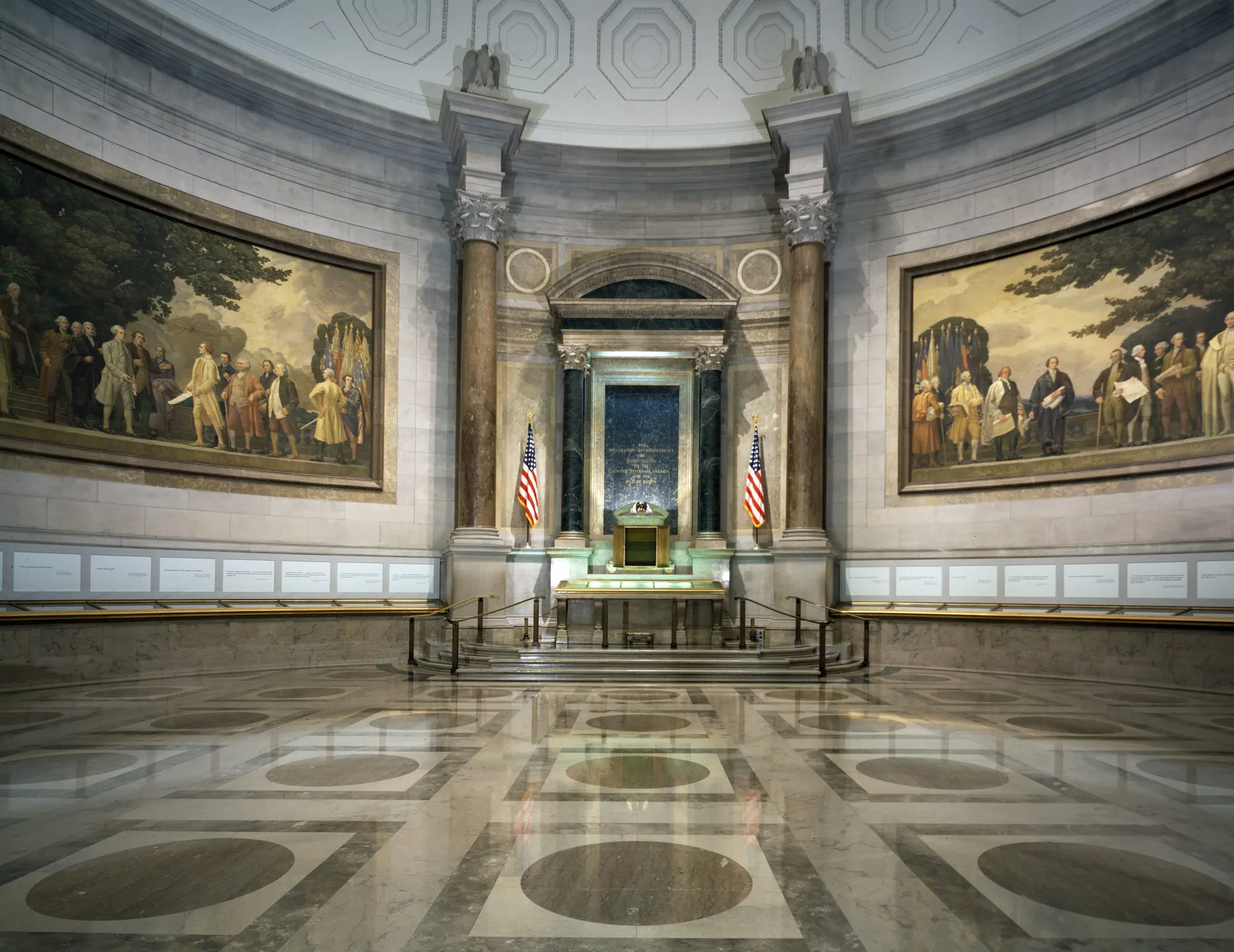
- Charters of Freedom Hall, National Archives, Washington, D.C LCCN2011630817 by Carol M. Highsmith, Public Domain. Source.
Updated October 31, 2026