How to run parent teacher conferences: a 15 minute agenda, the words for hard news, and seven templates to copy
We read the teacher blogs that explain how they run conferences and wrote what they leave out, the words. A 15 minute agenda, a notes sheet, phrases for hard news, and the sign-up and follow-up messages, ready to copy.
A parent teacher conference runs well when three things were settled before the family sat down: what the family wants to talk about, the evidence in the folder, and the next step both sides will leave with. The teacher blogs we read split on the details, but those three show up on most of the pages, and they matter more than any opening line.
We do not narrate our own conferences on this site, so nothing here is a story from a room. We read the teacher blogs that explain how they run theirs, kept their names on their ideas, and wrote what those pages mostly leave out, which is the words. Seven templates sit below, each in its own box and ready to copy. They are written in your voice, so they say I where you would.
The order the blogs run it
Linda Kamp at Around the Kampfire gives the order most of the pages echo: introductions, something positive, learning goals and achievements, strengths and growth areas with examples, behavior concerns, time for questions, and what to practice at home. Her sample script tells the family the meeting should take about 15 minutes. Molly Schwab, who runs Firstieland, books 15 to 20 minute blocks and keeps the hard part away from both ends of the meeting. Her line is "Save the concerns for the middle of the conference," and she ends on a positive note.
The three parts of every conference
Whatever the grade level, the blogs split the work the same way.
BeforeA folder per student, a sign-up that asks the family for their question, and a plan for the one hard thing
DuringThe family's question first, a strength with a work sample, one growth area, one agreed next step
AfterA written follow-up with the plan in it, and a date to check
Before the family arrives: the sign-up message
Kamp sends a pre-conference form so families can choose a time and list their concerns, then confirms through the channel they already use, whether that is a letter, Dojo, Remind or email. She offers video or phone for tight schedules and blocks extra time for struggling students and families with concerns. Those are the four jobs the message below does in one note: a choice of times, a way to name a question, a way to ask for a different format, and a promise to confirm. The Spanish version is for families who read Spanish. Have a fluent reader check the wording before it goes out.
Sign-up message to families, email
Subject: Sign up for a conference with [Teacher name], [Class or grade]

Dear families,

Conferences for [Class or grade] are on [dates]. Each one is 15 minutes. We will cover how your child is doing, what is going well, and one goal for the next few weeks.

Please choose a time here by [deadline]: [sign-up link]

Before we meet, please tell me one thing you would like to talk about. You can write it in the sign-up form or reply to this message.

If none of the times work, reply with two or three that do, or ask for a phone or video conference. I will confirm every time in writing within [number] school days.

Thank you,
[Teacher name]
[Phone or email]
Sign-up message to families, short text
Hi, this is [Teacher name] from [Class or grade]. Conferences are [dates], 15 minutes each. Pick a time by [deadline]: [link]. Need another time or a call? Reply here and I will fit you in.
Sign-up message to families, in Spanish
Asunto: Reserve su cita de conferencia con [Nombre del maestro o de la maestra], [Grado o clase]

Estimadas familias:

Las conferencias de [Grado o clase] serán los días [fechas]. Cada una dura 15 minutos. Hablaremos de cómo le va a su hijo o hija, de lo que le sale bien y de una meta para las próximas semanas.

Por favor elija un horario aquí antes del [fecha límite]: [enlace de inscripción]

Antes de reunirnos, cuénteme un tema que le gustaría tratar. Puede escribirlo en el formulario o responder a este mensaje.

Si ninguno de los horarios le conviene, responda con dos o tres que sí le sirvan, o pida una llamada o una videollamada. Confirmaré cada cita por escrito dentro de [número] días escolares.

Gracias,
[Nombre del maestro o de la maestra]
[Teléfono o correo electrónico]
The 15 minutes, and the sheet that catches them
The agenda below compresses Kamp's order into a 15 minute block and borrows Schwab's placement of the hard part. Tammy at The Owl Teacher adds the two habits that hold it together: listen first, because you learn more by listening than by talking, and write down what families share right after the meeting ends. The notes sheet is built around that second habit, with a space for the family's own question at the top and a place for what each side agreed to do.
15 minute conference agenda
BEFORE THE FAMILY SITS DOWN
Open the folder: grades or level, two work samples (one strong, one that shows the growth area), your dated notes, and the question the family sent in.

0:00 to 1:00   Welcome, and their question first
Say: Welcome, come in. We have 15 minutes. I will share what I am seeing and what comes next, but first, what do you want to be sure we cover?
Write their answer at the top of the notes sheet.

1:00 to 3:00   One real strength
Show one work sample or tell one specific moment. Name the skill, not the personality.
Say: Here is something [Name] did that I want you to see.

3:00 to 8:00   Where [Name] is now
Share the grade or level and what it means in plain words. Use two work samples as evidence. Name one growth area only.
Say: Right now [Name] is [where]. The goal for this point in the year is [goal]. This piece shows what is working, and this one shows the next skill.

8:00 to 11:00   The hard part, if there is one
Stay with what you have seen and written down. Use I statements. Ask what the family sees at home.
Say: I have noticed [specific, observed]. What are you seeing at home?

11:00 to 13:00   The plan
Agree on one step for you, one for [Name], one for home. Ask how the home step would fit their week.
Say: Here is what I will do. Here is what [Name] will do. What would work for your family?

13:00 to 14:30   Their questions
Say: Do you have any other questions or concerns for me?

14:30 to 15:00   Close on a positive
Name one strength again. Say when you will follow up and how.
Say: Thank you for talking with me about [Name]. I will send a short note by [day] with what we agreed.

IF TIME RUNS OUT
Book a second meeting. Do not run into the next family's time.
Conference notes sheet
CONFERENCE NOTES

Student: [Name]
Date and time: [date, time]
Who came: [names]
Language or interpreter needed: [language, or none]

THEIR QUESTION (asked at the start)


STRENGTH SHARED
What I showed: [work sample]

GROWTH AREA (one only)
Evidence: [work sample, score or dated note]
What the family said about it:

WHAT WE AGREED
1. I will:
2. [Name] will:
3. At home:
Check in on: [date] by [email, call or note home]

QUESTIONS I COULD NOT ANSWER YET (reply by [date])


FOLLOW-UP SENT ON: [date]
When the news is hard
Kamp's separate post on difficult conversations is the most usable page in the set for this. Her swap of "You are not doing enough to help your child" for "I am concerned that ___ may need additional support at home" is the model for every pair below. She also asks teachers to stay on facts and observations, to keep other students' names out of the meeting, and to offer a solution and ask the parent how they see it. The pairs are ours, built on those moves.
Say this, not this for hard news
INSTEAD OF: "[Name] is struggling."
SAY: "In [subject], [Name] is working at [level or score]. The goal for this point in the year is [goal]. These two pieces show the gap."

INSTEAD OF: "You need to do more at home."
SAY: "I am concerned that [Name] may need more practice with [skill]. A five minute routine could help. How would that fit your evenings?"

INSTEAD OF: "This is easy. The rest of the class gets it."
SAY: "I want to find out what is getting in the way. When [Name] works on [task], what do you notice at home?"

INSTEAD OF: "[Name] is lazy" or "needs to try harder."
SAY: "[Name] finishes about [number] of [number] assignments. When the work gets longer, [Name] stops after [what you see]. I would like to work out why."

INSTEAD OF: "[Name] is a behavior problem."
SAY: "I have noticed that [Name] [specific behavior] during [time of day], about [how often]. Here is what I have tried: [steps]. Do you see this at home? What works there?"

INSTEAD OF: "Other students never do this."
SAY: "I can only speak about [Name] today. Here is what I see."

INSTEAD OF: "I am sure it will get better."
SAY: "Here is what progress will look like by [date], and how we will both know."

WHEN A PARENT IS UPSET:
SAY: "That makes sense. Tell me more about what you are seeing."
WHEN YOU DO NOT KNOW:
SAY: "Let me write that question down. I will get you an answer by [day]."
After: the follow-up email
Kamp's after-conference list is short: document the key points, follow up with the family as needed, update the student's file, and share what is relevant with the other teachers who see the child. Tammy ends every conference with a follow-up plan and asks families to follow up on the suggestions too. The email below turns both into one note that goes out the same day or the next, so the family has the agreement in writing before the details blur.
Follow-up email after the conference
Subject: Our conference about [Name]: what we agreed

Dear [Family name],

Thank you for meeting with me on [day]. Here is what we talked about, so we both have it in writing.

What is going well: [one specific strength]

What we are working on: [one growth area, in plain words]

What we agreed:
1. I will [action] by [date].
2. [Name] will [action].
3. At home, you will try [action], for [how long], [how often].

We will check in on [date] by [email, call or note home]. If anything changes before then, reply to this message and we will adjust the plan.

Thank you for being part of this.
[Teacher name]
[Phone or email]
What four of the teachers actually run
These are their conferences, in their words where we could keep them. The links go to the posts the ideas came from.
Sends a pre-conference form so families can pick times and list concerns, then confirms through the channel they already use. Offers video or phone conferences, and schedules extra time for struggling students or families with concerns: "Be sure you schedule enough conference time so you (and the parents) do not feel rushed."
Each student gets a folder holding test scores and growth, current grades, work samples that are strong and weak, observation notes, strengths and areas for improvement, the concerns she expects the family to raise, and the next steps she wants. For families she rarely contacts, the meeting doubles as a chance to share class news. Afterward she documents the key points, follows up, and updates the student's file.
Ten tips, and the ones that carry weight here are three. Speak in I statements. Keep to facts and observations, with phrasing like "I have noticed ___." Leave other students' names out of the meeting. The last tip may be the most useful of all: "The difficult conversation should NOT be the first time you talk to the parents." She suggests small check-ins all term, including a quick message after a weak spelling test, so the hard conversation lands on trust that already exists.
Keeps a hanging file for each student from the first day of school: parent notes, behavior reports, progress and testing reports, and work samples that are good and bad. The file is the evidence if a family questions something. Conferences run in 15 to 20 minute blocks, so she cannot cover everything and does not try.
Her post gives two openers. One is the question "Do you have any concerns or questions before we begin?" The other is a happy story or something she is proud of the child for. Her own concerns go in the middle, and the meeting ends on a positive note. She keeps sticky notes handy, jots notes or concerns during the meeting, and sticks them in the student's file.
Prepares for the questions families ask: special projects, grading and homework policies, behavior and social interaction. Her point is that the teacher's attitude sets the tone, because "this is their child with whom you are talking." She invites families to share, listens more than she talks, and writes down what they tell her immediately after the conference ends.
Her close has two parts. She summarizes the positives, the areas needing work and the recommendations, then ends with a follow-up plan and asks families to follow up on the suggestions as well.
The student-led version, and the only page here with a minute-by-minute agenda for 20 minutes. Two minutes of welcome and format, eight for the student to share a reflection form and two or three work samples, four for the teacher to add context, three for the family's questions and what they see at home, and three for the student to state one goal aloud and agree on next steps.
Students practice out loud with a partner for 10 to 15 minutes beforehand, one playing a family member who asks a follow-up question. The goal the student names gives the family something specific to follow up on at home.
What they say to stop saying
The most honest material on these pages is the list of lines teachers dropped. Two of them are worth keeping on a sticky note.
John T. McCrann, Education Week
A high school math teacher in New York City, writing in 2015, names three phrases he will not say at conferences. "Do your work," because it equates learning with finishing tasks and he would rather talk about the deeper goals. "This is easy," which he recalls hearing in his second year, when a principal told a student "This is so easy!" with the student's father in the room. His objection is that it oversimplifies a struggle and shuts down the question of what else is going on. And "Thank you so much for coming," because it casts families as doing him a favor.
What he does instead is greet families with a warm smile and "welcome to room 401, please come in and let's talk about what's going on in class."
Linda Kamp, Around the Kampfire
Her replacement line for the one that blames: not "You are not doing enough to help your child," but "I am concerned that ___ may need additional support at home." It puts the worry on the teacher's side of the table and leaves the parent a way to answer.
So the rule three of the five state outright
A conference ends with a plan the family can say back, and a date when someone checks it.
Kamp shares the plan and the home practice, Tammy ends with a follow-up plan, and Boschen's students name a goal aloud so everyone agrees on next steps. The agenda and the follow-up email above both point at that last minute.
Conference week, in four moves
Not a script. The sequence these pages follow, with the reason each piece sits where it does.
Two weeks out: send the sign-up
Use the email or text above. Ask for a question as well as a time, and offer a phone or video option for families who cannot come in. Kamp confirms every slot through the channel families already use.
The week before: fill the folders
Pull the grades, two work samples, your dated notes and the family's question. Schwab's hanging files turn this into gathering rather than hunting, if they have been filled since the first day of school. Block extra time for the families who need it.
Conference day: run the agenda, take the notes
Use the agenda and the notes sheet. Write on the sheet or on a sticky note during the meeting, and finish the sheet the minute the family leaves, while the details are fresh. Tammy writes down what families share immediately after.
Within a day: send the follow-up
The plan goes out in writing, with a date to check. Kamp and Tammy both end with a follow-up, and the email above is the written version.
What to skip
Making the conference the first time a family hears about a problem. Kamp's tenth tip is the plainest statement of it: small notes home all term, so that a hard message lands on trust that already exists.
Also skip the comparison. Kamp says to keep other students' names out of the meeting. The family came to hear about one child.
And skip the phrase that sounds like a verdict. The "This is so easy!" McCrann recalls from a principal closed down the question of what else was going on.
The files below
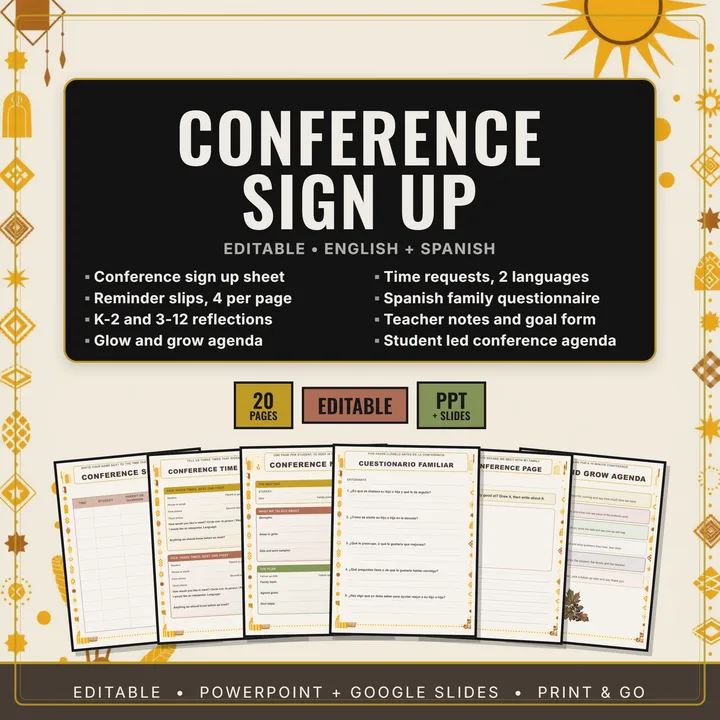
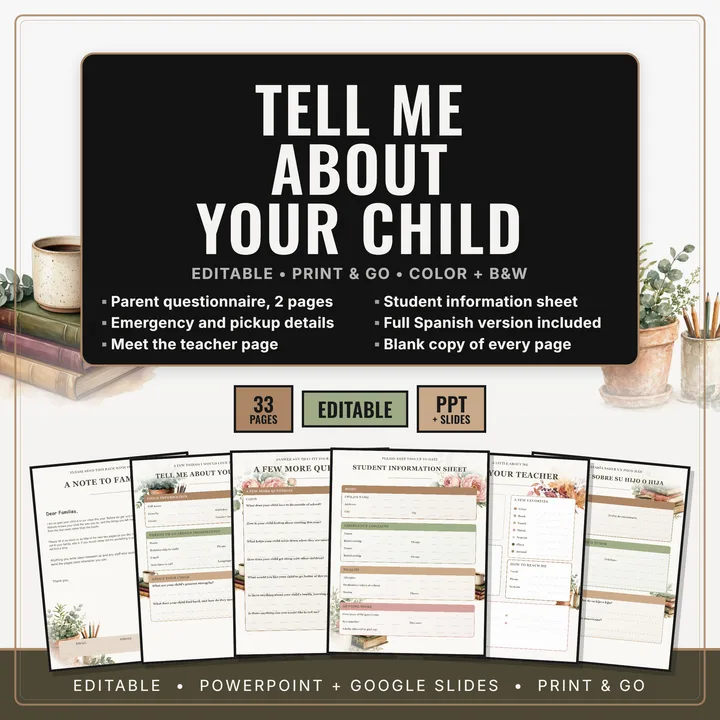
The templates above are plain text you can paste today. The set of conference forms below is the printed version: a sign-up sheet, reminder slips, a family questionnaire in English and Spanish, student reflection pages, a notes form, agendas, a goal setting form and thank-you notes, laid out and editable. The home school communication sheet and the monthly newsletter are for Kamp's tenth tip, the small notes that keep the hard conversation from being the first one. The free behavior tracker is the dated log that gives you the specifics for the middle of the meeting. It is free on Teachers Pay Teachers, and a free TPT account is needed to download it.
Ready made, from our store
Built to run the weeks above. The covers are the real pages.
Fifteen to twenty minutes is the usual block. Linda Kamp's sample script tells the family the meeting should take about 15 minutes, and Molly Schwab at Firstieland books 15 to 20 minute intervals. Kamp adds that students who are struggling, or families who list concerns on the sign-up form, get extra time so nobody feels rushed.
What do you say when the news is hard?
Say what you have seen, in specifics, and ask what the family sees at home. Kamp's example swaps "You are not doing enough to help your child" for "I am concerned that ___ may need additional support at home." Keep other students' names out of it, and make sure the meeting is not the first time the family hears about it. The say this, not this template on this page has seven swaps to copy and two lines for an upset parent and for a question you cannot answer yet.
What goes in the folder for each student?
Kamp lists test scores and growth, current grades, work samples that are strong and weak, observation notes, strengths and areas for improvement, the concerns you expect the family to raise, and the next steps you want. Schwab starts a hanging file on the first day of school with parent notes, behavior reports, progress and testing reports, and good and bad work samples.