How to write report card comments: one formula, 80 comments in five groups to copy, and what the teacher blogs say to cut
We read the blogs that teach report card comments and kept what they agree on: a strength with evidence, one growth area, one next step. Credited by name, with the formula and 80 original comments ready to copy.
A report card comment that families can use does three things: it names something the child does well and shows the evidence, it names one thing to work on in words a parent would use, and it gives a next step small enough to start this week. The three blogs we read give that formula three different names, and all three warn against the same failure, a comment a parent cannot act on.
We do not write report cards on this site, so nothing here is a story from a room. We read the blogs that teach report card comments, kept the names on their ideas, and wrote the part you can use directly: a formula to fill in and 80 original comments in five groups. Each group is in its own box and ready to copy. The blogs are credited by name, and the formula and the comments are ours.
The formula
Jessica Boschen at What I Have Learned writes it as "strength + evidence + next step" and aims for two to four sentences. Rebecca Davies at Differentiated Teaching opens with a strength, names a growth area and suggests a next step, and says the structure works only when each part is specific enough to act on. Jill and Cathy at The Curriculum Corner teach it as "2 strengths and a wish!": a positive, an area for improvement, and another strength to end on.
The frame below keeps the three parts and leaves the ending to you. Fill it for one student, then read it as a parent would.
Comment formula
STRENGTH WITH EVIDENCE
[Name] [does what well], shown by [the work, score or moment].

ONE GROWTH AREA, IN PLAIN WORDS
[Name] is working on [one skill]. Right now [what it looks like]. By the end of the term the goal is [what it should look like].

ONE NEXT STEP, SMALL ENOUGH TO DO THIS WEEK
[Who] will [what], for [how long], [how often].

OPTIONAL CLOSER
Please contact [teacher] at [email or phone] if you would like to talk about this.

CHECK BEFORE YOU PASTE
Would a parent know what this means without help? Could they do the next step tonight? Is there a detail in it that came from your own notes?
The comment bank: 80 comments in five groups
Brackets show what to swap. Every comment uses [Name] rather than he or she, so there is nothing to change but the brackets. Boschen's advice for any bank applies to this one: swap in the name and add one specific detail you have observed. Pick one or two from the strengths, one from areas to grow or work habits, and finish with a next step.
Strengths
Report card comments, strengths
[Name] explains thinking clearly in [subject], using examples and details that make the reasoning easy to follow.
[Name] reads closely and supports answers with details from the text.
[Name] has grown in [skill] this term and can now complete [task] with very little help.
[Name] asks questions that move the whole class's thinking forward.
[Name] writes with a clear main idea and sentences that build on each other.
[Name] solves problems in more than one way and can explain why each way works.
[Name] notices patterns quickly and uses them to check answers.
[Name] listens to classmates and adds ideas that connect to what was just said.
[Name] shows real curiosity about [topic] and often brings in questions or examples from outside class.
[Name] stays with hard problems longer than at the start of the term and tries a new approach when the first one does not work.
[Name] uses new vocabulary in speaking and writing without being reminded.
[Name] revises work after feedback, and the second drafts are noticeably stronger.
[Name] works well with different partners and keeps a group on task.
[Name] reads aloud smoothly and with expression, which shows strong understanding of the text.
[Name] has built a solid foundation in [skill], and the work shows it.
[Name] shares answers even when unsure, which helps the whole class learn.
Areas to grow
These use the "working on" opening from The Curriculum Corner, and each names the evidence so the sentence tells a parent something. Fill the brackets with a level, a score or a pattern you have seen.
Report card comments, areas to grow
[Name] is working on checking answers before turning work in. Careless errors in [skill] are costing points that a quick recheck would keep.
[Name] is working on adding details to writing. Most pieces have a clear idea but stop before explaining it.
[Name] is working on [skill] and is currently at [level or score]. The goal for this term is [level or score].
[Name] is working on reading directions all the way through before starting. Several mistakes this term came from a missed step, not from a gap in understanding.
[Name] is working on explaining answers in words as well as numbers.
[Name] is working on recalling [facts or vocabulary] quickly. Slow recall makes longer tasks take much more time than they should.
[Name] is working on staying with a task when it gets difficult. Work often stops at the first hard step.
[Name] is working on using evidence in written answers. Opinions are clear, but the supporting details are missing.
[Name] is working on spelling common words, which often distracts from otherwise strong ideas.
[Name] is working on speaking up in class. The written work shows ideas worth sharing.
[Name] is working on organizing writing into paragraphs. The ideas are there, but they run together.
[Name] is working on applying lessons to new kinds of problems. Practice problems go well, and unfamiliar formats cause hesitation.
[Name] is working on asking for help early. Waiting until a unit is nearly over has made gaps harder to close.
[Name] is working on handwriting that is easy to read. Slowing down on the first draft would help.
[Name] is working on reading at a pace that supports understanding. Rereading hard parts is a strategy to build.
[Name] is working on finishing independent work in the time given. Most of the work is correct when it is complete.
Work habits
Report card comments, work habits
[Name] arrives ready to learn with materials and a plan for the work.
[Name] starts tasks right away and uses work time well.
[Name] turns in work on time, and it is complete.
[Name] keeps notebooks and folders organized and finds materials quickly.
[Name] follows multi-step directions without needing them repeated.
[Name] takes pride in work, and the care shows in how it is presented.
[Name] checks work against the rubric before turning it in.
[Name] breaks long assignments into smaller steps and plans ahead.
[Name] often finishes early and chooses useful extension work without prompting.
[Name] needs reminders to begin tasks. A written checklist at the start of work time has helped.
[Name] has missed several assignments this term. A weekly look at the missing work list would help catch up.
[Name] rushes through independent work. Slowing down to check each answer would raise grades.
[Name] loses materials often. A set place for papers in the backpack would help.
[Name] is easily distracted during independent work and does best when seated near [location].
[Name] works independently and asks for help only after trying first.
[Name] returns signed forms and homework on the due date.
Behavior
Report card comments, behavior
[Name] is kind and respectful to classmates and adults.
[Name] follows class routines without reminders.
[Name] handles disagreements calmly and works toward a fair solution.
[Name] is a positive presence in class and often helps others without being asked.
[Name] takes responsibility for mistakes and moves forward.
[Name] takes good care of classroom materials and shared space.
[Name] accepts correction well and makes a change right away.
[Name] includes classmates in activities and groups.
[Name] is learning to wait for a turn to speak. Raising a hand has improved this term.
[Name] sometimes talks during instruction, which affects focus for [Name] and others. A quiet signal agreed on with the teacher has helped.
[Name] is learning to keep hands and objects to self during lessons.
[Name] needs reminders to use a respectful tone with classmates when frustrated.
[Name] is learning to move from a frustrating moment back to the work. A short break, then a return, has been working.
[Name] follows expectations in the hallway and in other classes.
[Name] uses technology only for the assigned task.
[Name] is honest, even when it is hard, and classmates and teachers trust that.
Next steps
These end a comment. Each is a task with a time attached, which is Davies's test for a next step that works. Her example of one that does not is "Continue to support your child at home."
Report card comments, next steps
Reading together for 10 minutes each night and asking [Name] to retell what happened will build comprehension.
Practicing [math facts] for five minutes a day, in short sessions, is the quickest way to build speed.
Writing two sentences about each day's reading will strengthen both writing and understanding.
Before turning in work, [Name] can use a three-item check: name on the paper, directions followed, each answer checked once.
A regular homework time and place at home, with phones away, will help [Name] finish on time.
A weekly look at the missing work list with a family member, until all work is in, will close the gaps.
[Name] will meet with the teacher on [day] for extra help with [skill] until the next unit.
Choosing books at the right level each week from the class library will keep reading growth steady.
Asking [Name] to teach a family member what was learned in class is a strong way to check understanding.
A weekly goal, chosen by [Name] and written in the planner, will build ownership of progress.
Redoing the corrected problems from each returned test and explaining each fix aloud will turn mistakes into progress.
Writing down one question before each class gives [Name] a way to speak up.
Looking over the planner together on Sunday evening will prepare [Name] for the week.
Practicing [skill] with [resource] for 10 minutes, three times a week, is the next step.
A check-in on [date] will show whether this plan is working. Please contact [teacher] with any questions before then.
Next term's focus is [skill]. Keeping up the current routine over the break will protect the progress made.
What the four pages actually say
These are their methods, in their words where we could keep them. The links go to the posts the ideas came from.
Writes the formula as "strength + evidence + next step" and keeps a comment to two to four sentences: one for a strength, one for progress or growth, and one suggestion if it is needed. Her bank is grouped by purpose: opening and closing comments, academic progress by subject, needs improvement, work habits and quality of work, classroom behavior, and social skills and character.
Her warnings are about words. "Needs to try harder" and "could do better" give a family nothing to change, so she names the skill and one next step instead, such as a practice, a routine, a strategy or support. For struggling students she pairs the concern with encouragement and a specific strategy, and she suggests student self-reflection sheets to set goals and give talking points for parent conferences.
Three tests for a comment: it is specific, naming the skill or behavior; honest, saying where the student really is; and it includes a concrete next step. A weak next step is "Continue to support your child at home." A stronger one is a defined task, such as 10 minutes of practice a night. Two to four sentences, unless the school sets a limit.
On tone, comments for kindergarten through grade 2 are more developmental and less evaluative, and upper elementary comments explain what a gap means for next year. On bad news she says to use clear language instead of vague reassurance: state plainly that the student is below grade-level expectations, explain what that means, and close with an invitation to a follow-up conversation.
Their formula is "2 strengths and a wish!": a positive, an area for improvement, and another strength to end on, the same pattern they teach students for peer feedback. For growth areas, begin with "working on," as in "working on improving responsibility" in place of "is not responsible."
They ask for honesty without harshness, and for something actionable instead of a label: rather than saying a child is below grade level, name the current reading level and suggest a step such as reading together for 10 minutes a night. They also say to comment only on skills you have actually taught, to reread for kindness because tone can be misread in writing, and to keep data on hand in student data binders and "I Can" checklists.
Four tips for students with learning differences. Keep the student's individual goals in mind, and praise the process and progress instead of comparing to grade-level standards. Mention modifications. Talk with students before writing, or use reflection worksheets. And leave no surprises: share concerns and positives as they arise instead of waiting for the report card.
On accommodations, the article says that if a student's accommodations should change, that goes to the case manager and the IEP or 504 team, not onto the report card.
The phrases they cut
None of the four pages confesses a bad report card. Each one does name the lines that fail families, and the overlap is the useful part.
Jessica Boschen, What I Have Learned
"Needs to try harder" and "could do better." A family cannot tell what to change from either one. The replacement names the skill and gives one next step.
Rebecca Davies, Differentiated Teaching
Over-softening, such as "room to grow" for a student who is significantly behind. Generic praise that does not describe the student. Next steps nobody can act on. Jargon such as "phonemic awareness" or "self-regulation" with no plain-language explanation. And comparisons to other students.
Jill and Cathy, The Curriculum Corner
"Is not responsible," which becomes "working on improving responsibility." And a comment on a skill that was never taught, such as poor small-group work in a room where cooperative learning has not been built.
So the rule the three blogs agree on
A comment is finished when a parent could act on every sentence of it.
Praise with evidence, name one skill, give one next step, and cut anything a parent would have to ask you to explain.
Writing a set of comments, in four moves
Not a script. The order these pages imply, with the reason each piece sits where it does.
Gather one strength, one growth area, one next step per student
From your data and from the student. The Curriculum Corner keeps data in student binders and "I Can" checklists. Boschen and Understood both point to student reflection sheets.
Pick from the bank, then paste
Choose one or two strengths, one growth area or habit, and a next step. If a student is far behind, start from a specific positive that is true, then use the plain statement Davies describes.
Add a detail from your own observation
Boschen's rule for any bank. A work sample, a moment or a number all work. This is what turns a bank comment into a comment about this student.
Read it as the parent would
The Curriculum Corner says to reread for kindness, because tone can be misread in writing, and to proofread, because the report card also reflects on the teacher. Then check that nothing in it is news the family has not already heard. Understood says to share concerns as they arise.
What to skip
The all-purpose comment. Davies lists generic praise that does not describe the student. Some lines in the bank are broad on purpose, so they are starting points and not finished comments. If a comment could go on any student's report card, it needs its detail before it goes out.
Also skip the sandwich when the news is plain. "2 strengths and a wish" is a fine structure for most students, and Davies is just as clear that over-softening a real gap with a phrase like "room to grow" fails the family. Use the kind frame for most, and the plain statement for the student who is far behind.
Want more
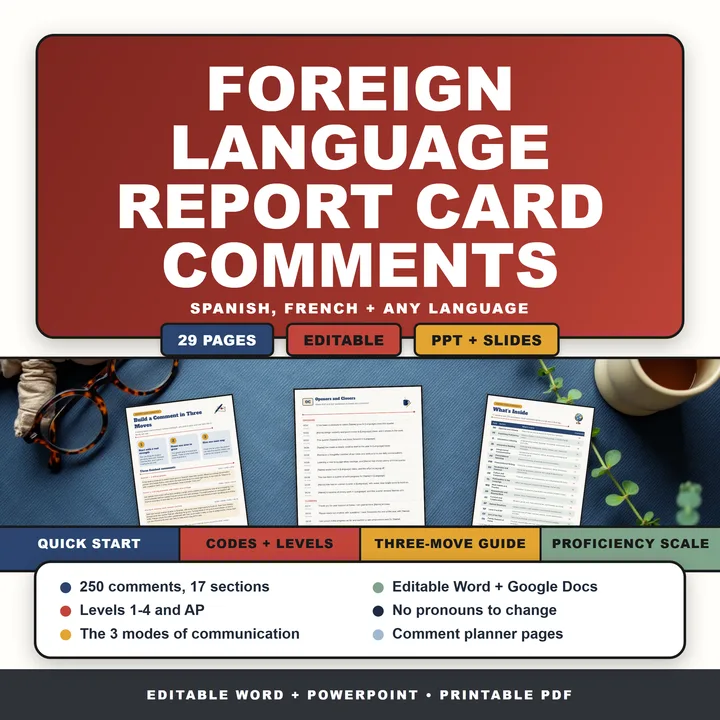
If you teach a world language, the same formula carries over. Swap the brackets for what your course actually assesses, such as holding a short conversation or writing a paragraph in the language. The free sampler below has 50 report card comments for Spanish, French and other world language classes, written in English for families. It is free on Teachers Pay Teachers, and a free TPT account is needed to download it. The paid bank, Foreign Language Report Card Comments, has 250 comments for grades 6 to 12 in 17 sections.
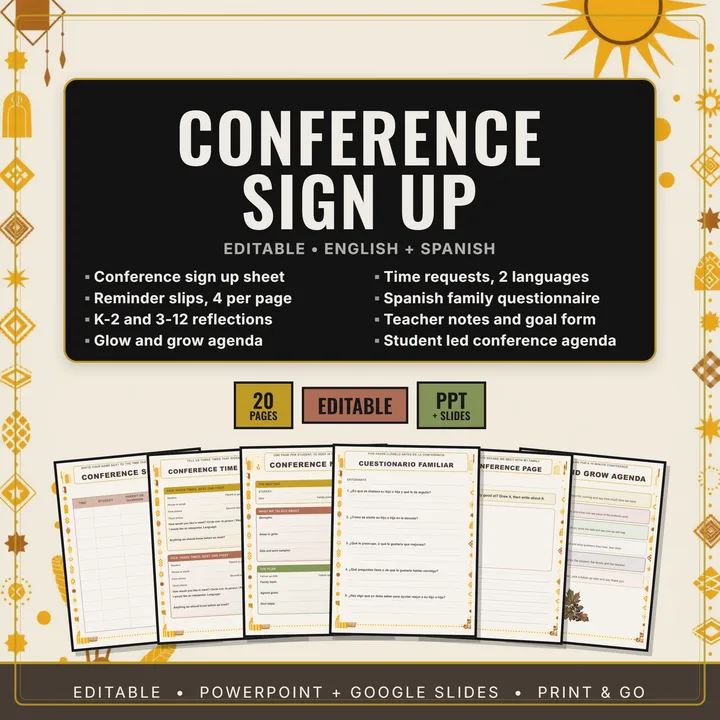
The parent teacher conference forms below are the next step after the comments go home. The home school communication sheet is for the small notes during the term that keep a report card from holding any surprises, which is the point Understood makes. The behavior calendar is a dated place to keep those notes.
Ready made, from our store
Built to run the weeks above. The covers are the real pages.
Two to four sentences if your school sets no limit. Jessica Boschen gives one sentence to a strength, one to progress or growth, and one to a suggestion if it is needed. Rebecca Davies gives the same range as one specific strength, one growth area with a concrete example and one next step. If your report card system caps the length, the cap wins, and the formula still works at one sentence per part.
How do I write a comment for a student who is far behind?
Say it in clear language. Davies says to state plainly that the student is below grade-level expectations, explain what that means, and close with an invitation to a follow-up conversation, after opening with a specific positive that is true. The Curriculum Corner names the current level and a step, such as reading together for 10 minutes a night, instead of leaving the label alone.
Is it okay to use a comment bank?
Yes, as a starting point. Boschen's method is to swap in the student's name and add one specific detail you have observed. The bank on this page is written to be edited that way. Each group copies at once, then you change the brackets and add a detail from your own observation.