The Everything Educator

Teacher to teacher

How to use a visual schedule: where it goes, who moves the cards, and the four things that quietly break it

We read the special education blogs that hold the first page for this, plus the research summary they all sit on, and pulled out the part they are weakest on: running the schedule day to day. Credited by name, with the cards and boards to print.

Updated 2026-09-07

A visual schedule works when it sits at the student's eye level on a path they already walk, when the student is the one who moves the card, and when checking it is a taught routine with a consistent cue rather than something an adult announces. Placement, ownership and a cue. The picture set matters far less than any of the three.

We do not run a special education classroom, so this is not a diary and it is not clinical advice. We read the practitioner pages that hold the first page for "visual schedule classroom special education how to use," kept their names on their ideas, and put them in the order a schedule actually gets built. Where a claim is about evidence rather than practice, it is sourced to the review it comes from.

What the research says, and what it does not

Visual supports are on the list of focused interventions that met evidence-based practice criteria in the 2020 systematic review published by the National Clearinghouse on Autism Evidence and Practice at UNC's Frank Porter Graham Child Development Institute, on 104 single case design studies and 2 group design studies, across ages 0 to 22, with outcomes reported in academic, behavior, communication, social and vocational domains.

What that does not say is that hanging a schedule on a wall does anything. The studies are of taught, prompted and faded use. Every failure the practitioners below describe is a failure of the teaching, not of the pictures.

The four schedules, and which question each one answers

Most rooms need more than one of these at the same time, which is the part a single wall chart cannot cover.

  • Group scheduleWhat the class is doing today, on a board everyone can see. Answers "what is happening"
  • Individual scheduleOne student's whole day, start to finish, in their format. Answers "what happens to me"
  • First and thenTwo cards. Answers only "what comes after this," for a hard transition or a new user
  • Mini scheduleThe steps inside one activity or routine. Answers "how far through am I"

What the practitioners actually run

Four pages, credited. The links go to the posts the ideas came from.

Christine Reeve, PhD, BCBA-D

Autism Classroom Resources

The most operational page on the list, and the one that separates a group schedule from an individual schedule properly: the group board says what the class is doing, the individual schedule shows one student the whole day and is, in her words, the backbone of a well structured classroom.

Her placement rule is eye level and a consistent location. Her ownership rule is that the student actively manipulates it, moving a clip or crossing off items, rather than looking at it. And her teaching sequence is a fading hierarchy: full physical prompting, then a point or visual prompt, then no prompt.

Melissa Finch

Autism Adventures

The clearest description of a check, start to finish. The student works top to bottom: take the first icon, place it on the "what time is it" board, do the activity, put the card in the finished pocket, come back for the next one.

She runs several formats at once, from a magnetic board at the front of the room to individual binder schedules students carry between rooms, and she is explicit that the format is chosen for the student rather than as a level to be graduated from.

Transition Abilities

Transition Abilities

The high school version, which is mostly a dignity problem. A schedule on a tablet or a phone, or a checklist for packing up, is age appropriate in a way a laminated picture strip is not, and it is closer to what the student will use after graduation.

The independence path is the same as Reeve's, described from the other end: at first an adult gives the signal to check, and over time students start checking on their own.

Cultivating Exceptional Minds

Cultivating Exceptional Minds

Model first, then reduce support as the student gets comfortable. Pair the schedule with a transition warning rather than expecting the schedule to carry the transition alone.

On refusal, the recommendation is patience, consistency, gradual exposure and reinforcement, rather than removing the schedule and trying a different one.

The four things that quietly break it

These are Christine Reeve's failure points, and they are the reason a room can have a beautiful schedule and no benefit from it. Not one of them is about the cards.

The classroom schedule itself is not organized

A visual schedule is a picture of the day. If the day changes constantly, the picture is wrong, and a wrong schedule teaches a student that the schedule cannot be trusted.

Reeve's fix is to get the actual sequence of the day stable first. Students will not benefit from a visual schedule if the events of the day are unorganized, and no amount of laminating changes that.

The schedule was hung, not taught

Nobody taught the check, so the check never happens without an adult saying the whole sentence.

The adults are not consistent

One teacher prompts the check, the para says "line up," and the student now has two systems. The cue has to be the same words from every adult in the room.

Changes reach the student some other way

A canceled activity that is still on the board, or a change the student hears about from a classmate, costs more trust than the change itself was worth.

So the rule underneath all four

The schedule is not the pictures. It is a taught routine that a student runs, and the adults' job is to fade out of it.

If an adult still has to move a card or say the transition, the schedule is not yet doing the work; it is describing work an adult is doing.

Teaching it, in four stages

This is Reeve's prompt-fading hierarchy applied to the check routine Melissa Finch describes. Move a stage only when the previous one is boring.

Hand over hand

The adult gives the cue, walks the student to the schedule, and physically helps them take the card, carry it and place it. The student does the moving even though the adult is doing the guiding. Nothing is faded yet.

The cue plus a gesture

Same words every time, from every adult. The point replaces the hands. The student takes the card, places it, does the activity and returns the card to the finished pocket without being walked.

The cue alone

The adult says the cue from across the room. This is the stage most rooms stop at, and it is the one where a para who is trying to be helpful can quietly undo six weeks of work.

The student checks unprompted

A timer, the end of an activity or the transition itself becomes the cue. For older students, Transition Abilities' checklist and phone formats live here, because this is where the schedule stops being a classroom support and starts being a life skill.

What to skip

Skip redesigning the layout mid-year because it looks dated. The cards change daily and the layout does not change at all. Predictability is the intervention, and a fresh design costs a week of re-teaching to buy nothing.

Skip treating the formats as a ladder. Melissa Finch is explicit that a picture schedule is not a stage a student graduates out of into a written one. The format is chosen for the student, and choosing objects for a student who reads is as wrong as choosing text for a student who does not.

The cards and boards below

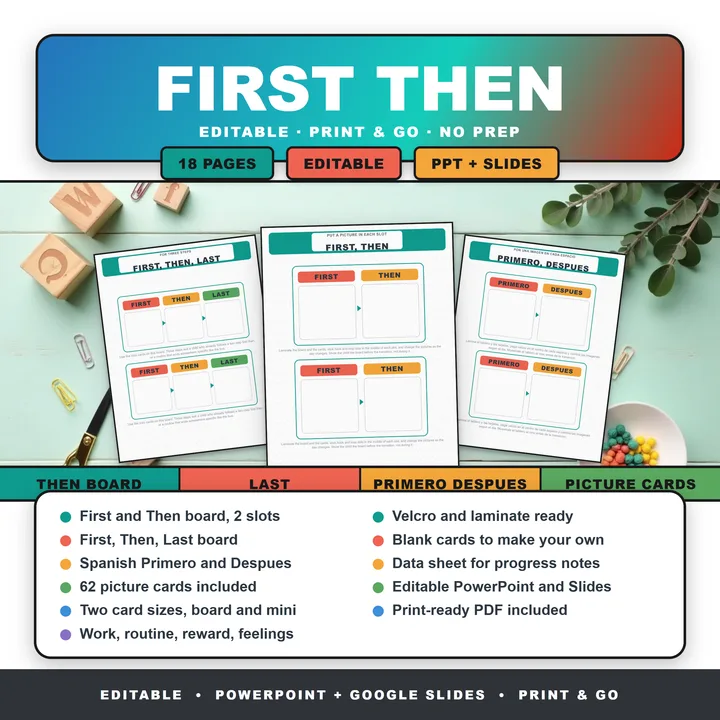
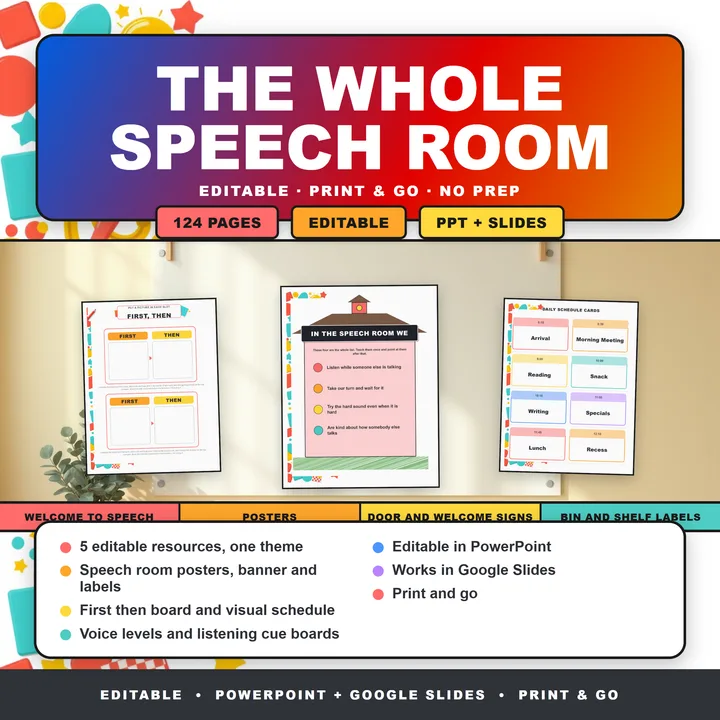
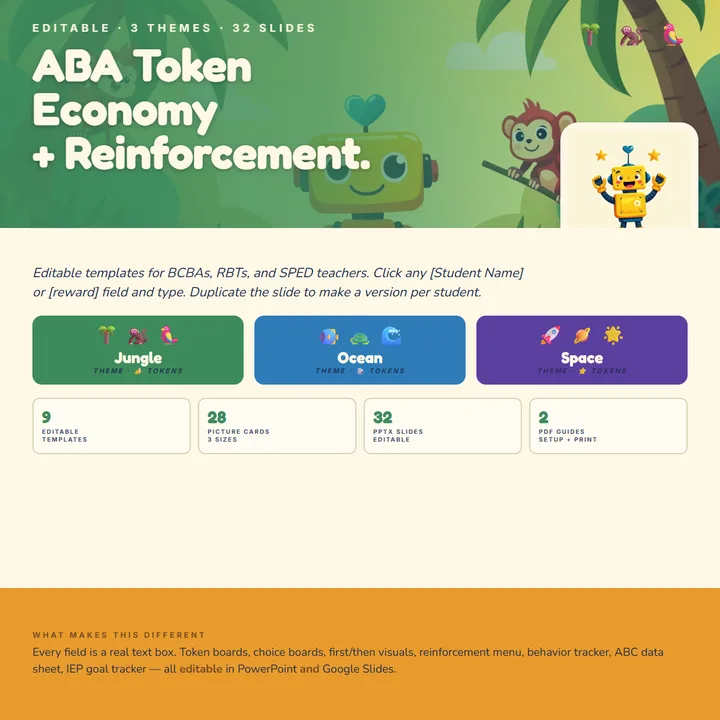
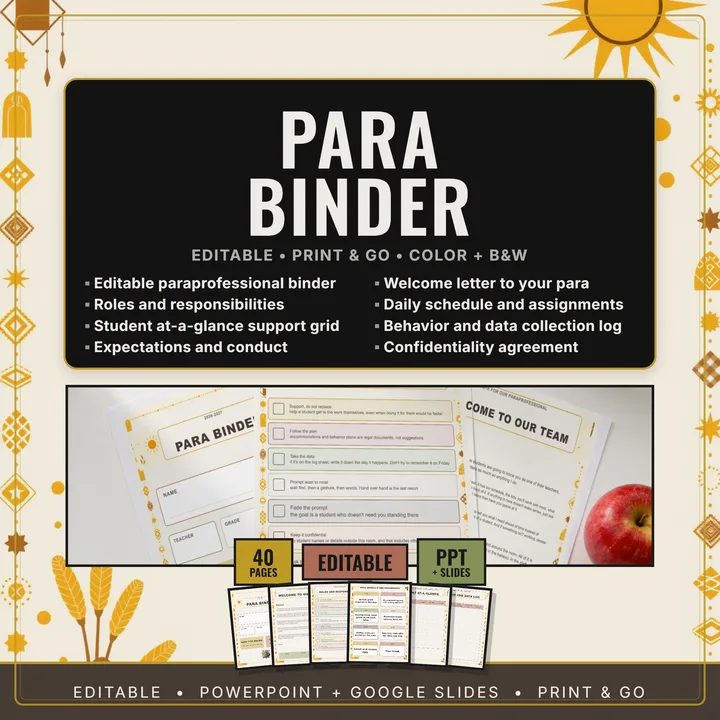
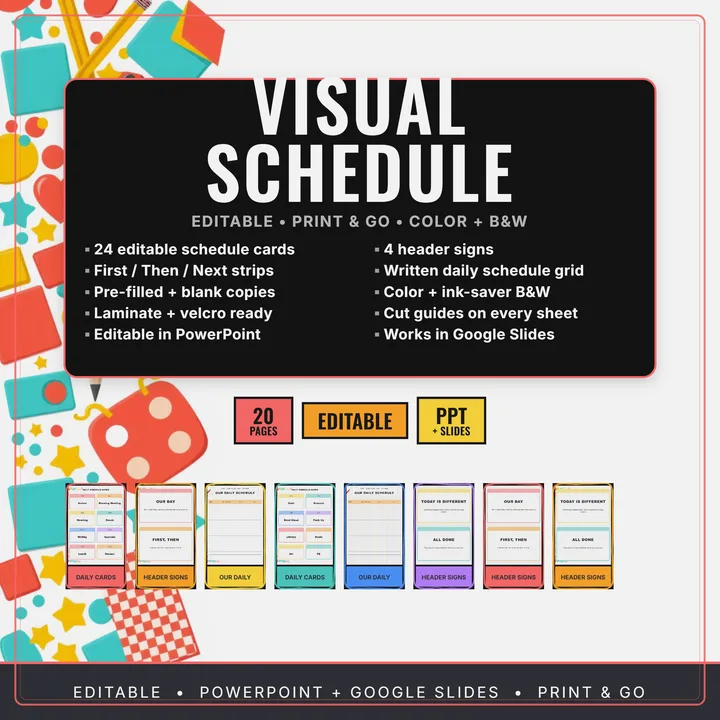
The schedule cards, the first-and-then board, the room bundle and the para binder are ours. They are editable so the wording matches the cue your room already uses, which matters more here than on any other page: two different phrasings of the same prompt is one of the four failure points above. There is no free file on this page yet. A first-and-then sampler is the obvious one and it is not built, so rather than point you at something unrelated we have left the space empty.

Questions teachers ask

Where should a visual schedule go?
At the student's eye level and on their path, not behind the teacher desk. Christine Reeve puts it plainly: the location has to be consistent and reachable. A schedule a student has to be walked to is a schedule the adult is running.
Who moves the cards?
The student, from the first day, even if it is hand over hand at the start. Reeve's point is that the student has to actively manipulate the schedule, moving a card or crossing off a line, because the moving is what builds the ownership. The moment the adult moves the cards it becomes the adult's schedule.
What is a first-and-then strip for?
A two-card strip for the moments a whole-day schedule is too much information, and for students new to schedules. It pairs one thing that has to happen with one thing that is worth happening, and it answers only the next question the student has.
How often should the schedule change?
The layout should not change. The cards change daily, and a canceled activity has to be changed on the schedule before the student finds out any other way. Predictability is the intervention, so a redesign mid-year costs more than the improvement is worth.
Editable  •  PowerPoint  •  Google Slides  •  Print and Go